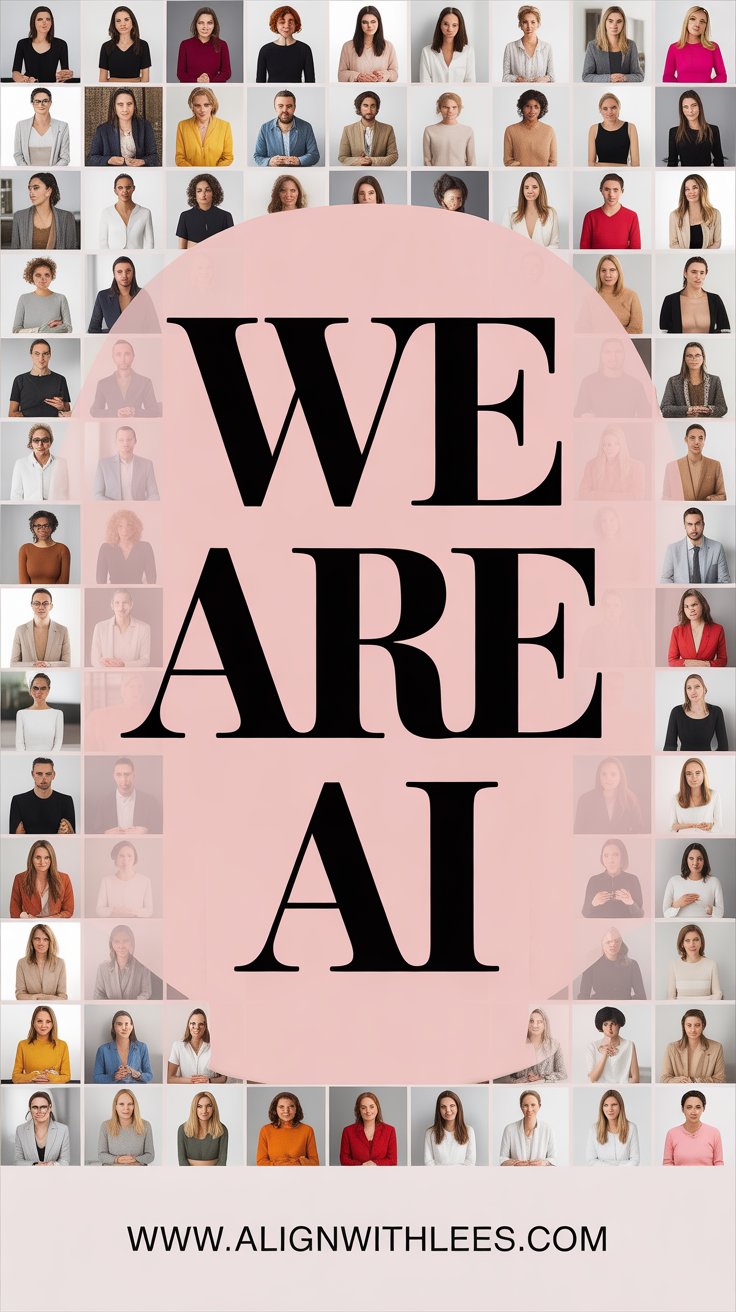
I recently found myself in a room with eighty coaches from around the world tuning in to learn about AI and the Future of Coaching. Not a physical room, but a digital space where we all gathered for one specific reason: to understand how artificial intelligence is reshaping the coaching industry and to do it responsibly.
The conversation wasn’t what I expected. These weren’t tech evangelists hyping up the latest shiny tool. These were seasoned professionals who had built their practices on human connection, ethical standards, and genuine transformation. And they were concerned.
Most of the group shared the same worry: ethics. How do we use AI without compromising the integrity of our work? How do we protect client data? How do we guide entrepreneurs to leverage these tools without manipulating outcomes they don’t fully understand?
These questions matter. Because as entrepreneurs, we’re being told AI is the future. That if we’re not using an AI self-development coach or AI-powered coaching tools, we’re falling behind. But nobody’s really talking about what AI can’t do, what it gets wrong, and how to use it without losing the human element that makes coaching actually work.
So here’s what I learned from sitting in that digital room, listening to coaches navigate this new territory together.
What AI Is Not
Let me start here because this is where most of the confusion lives.
AI is not a replacement for human judgment. It’s not capable of reading the room, sensing when someone’s about to have a breakthrough, or knowing when to push harder versus when to hold space. An AI coach for entrepreneurs can provide frameworks, generate ideas, and offer structure. But it cannot replicate the consciousness that comes from lived experience.
AI is also not uniform. This was one of the biggest takeaways for me. Not all AI tools are built the same way. They don’t have the same training data. They don’t have the same capabilities. And they definitely don’t have the same ethical guardrails. Understanding what a specific AI tool is actually trained to do changes everything about how you leverage it.
Think about it like this: you wouldn’t use a hammer to paint a wall. But if all you’ve heard is “tools are useful,” you might try. The same applies to AI. Knowing what it’s designed for helps you use it correctly.
What AI Is Not Capable Of
Here’s where things get interesting. And a little unsettling.
AI will make things up. Not because it’s lying, but because it’s designed to generate responses based on patterns. If it doesn’t know something, it will confidently create people, events, statistics, even legal cases or scientific studies that don’t exist. I watched this happen in real time during our training. Someone asked a question, got a detailed response with citations, and when we fact-checked it, half of the sources were fabricated.
This isn’t a minor issue. If you’re building a business, making decisions, or advising clients based on AI-generated information, and you don’t verify it, you’re building on quicksand.
AI is also not always up to date. Depending on the tool you’re using, the information it’s trained on might be months or years old. That impacts the quality of your work. Bad input equals bad output. If you’re feeding it outdated information or unclear prompts, you’re getting unreliable results.
How Coaching Will Evolve With AI
The coaches in that room weren’t anti-AI. They were pro-integrity. And that distinction matters.
AI-powered coaching is going to become more prevalent. That’s not a maybe. It’s already happening. But the coaches who will thrive aren’t the ones who replace human connection with automation. They’re the ones who use AI to enhance their work while maintaining the core of what makes coaching effective: empathy, presence, and accountability.
AI can help coaches scale their impact. It can generate session frameworks, create personalized action plans, and even help clients track progress between sessions. But it can’t replace the moment when a coach sees something in you that you don’t see in yourself yet. It can’t hold you accountable when you’re avoiding the hard conversation. It can’t feel the energy shift when you’re about to quit versus when you’re about to break through.
The future of coaching isn’t human versus AI. It’s human with AI as a tool, used intentionally and ethically.
The Foundation: Prompting Is Like Steering a Ship
One of the most valuable things I learned is that prompting is the foundation of working with AI. Not just typing questions into a chatbot, but actually understanding how to guide the AI toward useful outputs.
Think of it like steering a ship. If you don’t know where you’re going, the ship will drift. If you give vague directions, you’ll end up somewhere, but probably not where you intended. If you’re specific, intentional, and understand the capabilities of your vessel, you can navigate toward your destination efficiently.
Prompting with AI works the same way. The quality of what you get depends entirely on how well you steer it. Most people type in surface-level questions and get surface-level answers. Then they assume AI isn’t useful. But when you learn to prompt with clarity, context, and specificity, AI becomes a powerful leverage tool.
This is especially true for entrepreneurs using AI as a self-development coach. You’re not just asking “How do I grow my business?” You’re framing the question with your specific context, constraints, goals, and values. You’re guiding the AI to give you something actually applicable to your situation.
My Final Thoughts on AI and the Future of Coaching
I see this technology being beneficial. But only if we use it correctly.
AI cannot replicate consciousness. It cannot replace empathy. It cannot exercise good judgment in the nuanced, human way that coaching requires. And honestly, that’s a good thing. Because those are the elements that make coaching transformational.
But here’s the reality: AI is here. Entrepreneurs are using it. And if you’re going to leverage it for self-development, business growth, or decision-making, you need to understand its limitations and its potential.
Having a good coach or mentor becomes even more vital in an AI-integrated world. Not less. Because you need someone who understands both the human side and the AI side. Someone who can guide you to use these tools ethically, effectively, and in alignment with your values. Someone who’s actually trained in this specialty area, not just experimenting and hoping for the best.
That’s why I’m investing in this education. Not because I think AI is going to replace what I do, but because I believe the future of entrepreneurship requires us to understand how to use these tools without losing our integrity, our authenticity, or our humanity.
And if you’re an entrepreneur trying to figure out how to leverage AI without compromising your values or your business, you need support from someone who’s taken the time to understand this intersection deeply.
If you’re ready to explore AI and the Future of Coaching with someone who’s committed to doing it ethically and effectively, I’d recommend checking out The Ai Coach Growth Hub. It’s where I’m learning alongside other coaches and entrepreneurs who are committed to integrating AI responsibly. The focus isn’t just on tools. It’s on transformation, ethics, and building businesses that leverage AI without losing what makes us human.
Because at the end of the day, AI is a tool. And tools are only as good as the people wielding them.
This post contains affiliate links.